protagonist
A protagonist (from Ancient Greek πρωταγωνιστής (protagonistes), meaning "player of the first part, chief actor") is the main character in any story, such as a literary work or drama.
The protagonist is at the center of the story, should be making the difficult choices and key decisions, and should be experiencing the consequences of those decisions. The Protagonist can affect the main characters decisions. The protagonist should be propelling the story forward. If a story contains a subplot, or is a narrative that is made up of several stories, then there may be a character who is interpreted as the protagonist of each subplot or individual story.


Protagonist(film)
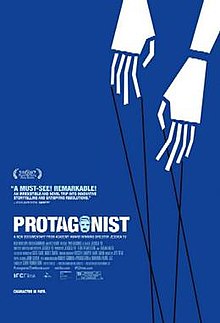
Protagonist is a 2007 documentary film about the parallels between human life and Euripidean dramatic structure. The film was written and directed by Jessica Yu.
It featured extensive interviews with German terrorist Hans-Joachim Klein, ex-gay Christian evangelist Mark Pierpont, Mexican bank-robber Joe Loya, and martial-arts enthusiast Mark Salzman (and the director's husband). Interspersed with the interviews are scenes from ancient Greek drama performed by puppets.
Bildungstroman
In literary criticism, a Bildungsroman (German pronunciation: [ˈbɪldʊŋs.ʁoˌmaːn]; German: "novel of formation, education, culture"),novel of formation, novel of education,or coming-of-age story (though it may also be known as a subset of the coming-of-age story) is a literary genre that focuses on the psychological and moral growth of the protagonist from youth to adulthood (coming of age), in which character change is extremely important.


antagonist
An antagonist is a character, group of characters, institution, or concept that stands in or represents opposition against which the protagonist(s) must contend. In other words, an antagonist is a person or a group of people who opposes a protagonist.


Theme(narrative)
In contemporary literary studies, a theme is the central topic a text treats.Themes can be divided into two categories: a work's thematic concept is what readers "think the work is about" and its thematic statement being "what the work says about the subject".
The most common contemporary understanding of theme is an idea or point that is central to a story, which can often be summed in a single word (e.g. love, death, betrayal). Typical examples of themes of this type are conflict between the individual and society; coming of age; humans in conflict with technology; nostalgia; and the dangers of unchecked ambition.[examples needed] A theme may be exemplified by the actions, utterances, or thoughts of a character in a novel. An example of this would be the theme loneliness in John Steinbeck's Of Mice and Men, wherein many of the characters seem to be lonely. It may differ from the thesis—the text's or author's implied worldview.[example needed]
website: http://penandthepad.com/theme-narrative-1732.html
Genre
Genre (/ˈʒɒ̃rə/, /ˈʒɒnrə/ or /ˈdʒɒnrə/; from French genre [ʒɑ̃ʁ(ə)], "kind" or "sort", from Latin genus (stem gener-), Greek γένος, gés) is any category of literature, music, or other forms of art or entertainment, whether written or spoken, audio or visual, based on some set of stylistic criteria. Genres form by conventions that change over time as new genres are invented and the use of old ones is discontinued. Often, works fit into multiple genres by way of borrowing and recombining these conventions.
Genre began as an absolute classification system for ancient Greek literature. Poetry, prose, and performance each had a specific and calculated style that related to the theme of the story. Speech patterns for comedy would not be appropriate for tragedy, and even actors were restricted to their genre under the assumption that a type of person could tell one type of story best. In later periods genres proliferated and developed in response to changes in audiences and creators. Genre became a dynamic tool to help the public make sense out of unpredictable art. Because art is often a response to a social state, in that people write/paint/sing/dance about what they know about, the use of genre as a tool must be able to adapt to changing meanings.
Didacticism
For the teaching method, see Didactic method.
"Didactic" redirects here. For the album by Means End, see The Didact.
Didactic method
A didactic method (Greek: διδάσκειν didáskein, "to teach") is a teaching method that follows a consistent "scientific" approach or educational style to present informations to student. The didactic method of instruction is often contrasted with dialectics and the Socratic method; the term can also be used to refer to a specific didactic method, as for instance constructivist didactics.


For example
“I love animals, e.g., dogs, pigs and cats." (O)
“I love animals, e.x., dogs, pigs and cats." (X)
“I love animals, e.x., dogs, pigs and cats." (X)
I know a few of great teachers (e.g., Mary, Sandy, Susan). (O)
I know a few of great teachers (e.g., Mary, Sandy, Susan, etc.) (X)
I know a few of great teachers (e.g., Mary, Sandy, Susan, etc.) (X)
It happened in August, i.e., two months ago. (O)
(i.e. = in other words)
It happened in August, e.g., two months ago. (X)
(e.g. = for example)
(i.e. = in other words)
It happened in August, e.g., two months ago. (X)
(e.g. = for example)
website: http://tw.blog.voicetube.com/archives/8076
Charles Perrault
Charles Perrault (French: [ʃaʁl pɛʁo]; 12 January 1628 – 16 May 1703) was a French author and member of the Académie Française. He laid the foundations for a new literary genre, the fairy tale, with his works derived from pre-existing folk tales. The best known of his tales include Le Petit Chaperon Rouge (Little Red Riding Hood), Cendrillon (Cinderella), Le Chat Botté (Puss in Boots), La Belle au bois Dormant (The Sleeping Beauty), and Barbe Bleue (Bluebeard). Some of Perrault's versions of old stories have influenced the German versions published by the Brothers Grimm more than 100 years later. The stories continue to be printed and have been adapted to opera, ballet (such as Tchaikovsky's The Sleeping Beauty), theatre, and film. Perrault was an influential figure in the 17th-century French literary scene, and was the leader of the Modern faction during the Quarrel of the Ancients and the Moderns.

hooding ceremony
Hooding ceremonies are carried out by institutions of higher education to recognize
students who have earned an advanced degree beyond the bachelor's degree. The
ceremony is a time when individual schools and programs can recognize the individual
accomplishments of their graduates in a more personal way than is permitted at the
university’s general commencement. During the ceremony each graduate comes
forward and has their hood placed over their head by the department head as their
names are read. The colorful hood of each university is reserved for those who satisfy
the requirements or advanced degrees. It is a special part of academic regalia and
denotes scholarly and professional achievements.


Hoodings
HOW ARE GRADUATION HOODINGS DIFFERENT FROM GRADUATION CEREMONIES?
The Hooding Ceremony is an event whereby recognition is given for those graduating with doctoral degrees. These individuals are doctoral candidates and will be full receipents of their doctorates at the graduation ceremonies. The Hooding Ceremony is symbolic of passing the guard from one generation of doctors to the next generation of doctors. During the ceremony a faculty advisor or Dean of the Graduate School place the doctoral hood over the head of the graduate, signifying his or her success in completing the graduate program. The ceremony is similar to a graduation in that faculty and students are dressed in academic attire. The Hooding Ceremony is in addition to and does not replace the Graduation Exercises.
Nursery rhyme
A nursery rhyme is a traditional poem or song for children in Britain and many other countries, but usage of the term only dates from the late 18th/early 19th century. In North America the term Mother Goose Rhymes, introduced in the mid-18th century, is still often used.
From the mid-16th century they begin to be recorded in English plays, and most popular nursery rhymes date from the 17th and 18th centuries.The first English collections, Tommy Thumb's Song Book and a sequel, Tommy Thumb's Pretty Song Book, were published before 1744. John Newbery's compilation of English rhymes, Mother Goose's Melody, or, Sonnets for the Cradle (London, c. 1765), is the first record we have of many classic rhymes, still in use today.

Jack and Jill
Jack and Jill went up the hill
To fetch a pail of water.
Jack fell down and broke his crown,
And Jill came tumbling after.
Up Jack got, and home did trot,
As fast as he could caper,
To old Dame Dob, who patched his nob
With vinegar and brown paper.


Humpty Dumpty
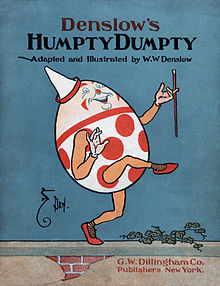
Humpty Dumpty is a character in an English nursery rhyme, probably originally a riddle and one of the best known in the English-speaking world. He is typically portrayed as an anthropomorphic egg, though he is not explicitly described so. The first recorded versions of the rhyme date from late eighteenth-century England and the tune from 1870 in James William Elliott's National Nursery Rhymes and Nursery Songs. Its origins are obscure and several theories have been advanced to suggest original meanings.
The character of Humpty Dumpty was popularised in the United States by actor George L. Fox (1825–77). As a character and literary allusion, he has appeared or been referred to in a large number of works of literature and popular culture, particularly Lewis Carroll's Through the Looking-Glass (1872). The rhyme is listed in the Roud Folk Song Index as No. 13026.
website: https://www.youtube.com/watch?v=6rmwFQTrtvk
Mother Goose
The figure of Mother Goose is the imaginary author of a collection of fairy tales and nursery rhymes often published as (Old) Mother Goose's Rhymes. As a character, she appears in one nursery rhyme.A Christmas pantomime called Mother Goose is often performed in the United Kingdom. The so-called "Mother Goose" rhymes and stories have formed the basis for many classic British pantomimes. Mother Goose is generally depicted in literature and book illustration as an elderly country woman in a tall hat and shawl, a costume identical to the peasant costume worn in Wales in the early 20th century, but is sometimes depicted as a goose (usually wearing a bonnet).


Once Upon a Time
Once Upon a Time is an American fairy tale television series that premiered on October 23, 2011, on ABC. The show takes place in the fictional seaside town of Storybrooke, Maine, whose residents are characters from various fairy tales transported to the "real world" town and robbed of their real memories by a powerful curse. Episodes typically feature a primary storyline in Storybrooke, as well as a secondary storyline from another point in a character's life before the curse was enacted. The show airs Sundays at 8:00 pm ET/7:00 pm CT.
It borrows elements and characters from the Disney-franchise and popular Western literature, folklore, and fairy tales. Once Upon a Time was created by Lost and Tron: Legacy writers Edward Kitsis and Adam Horowitz. A spin-off series, Once Upon a Time in Wonderland, consisting of 13 episodes, premiered on October 10, 2013, and concluded on April 3, 2014.On March 3, 2016, ABC renewed the series for a sixth season, which premiered on September 25, 2016.


The wheels on the bus go round and round lyrics
The wheels on the bus go round and round.
round and round.
round and round.
The wheels on the bus go round and round,
all through the town!
round and round.
round and round.
The wheels on the bus go round and round,
all through the town!
The people on the bus go up and down.
up and down.
up and down.
The people on the bus go up and down,
all through the town!
up and down.
up and down.
The people on the bus go up and down,
all through the town!
The horn on the bus goes beep, beep, beep.
beep, beep beep.
beep, beep, beep.
The horn on the bus goes beep, beep, beep.
all through the town!
beep, beep beep.
beep, beep, beep.
The horn on the bus goes beep, beep, beep.
all through the town!
The wipers on the bus go swish, swish, swish.
swish, swish, swish.
swish, swish, swish.
The wipers on the bus go swish, swish, swish,
all through the town!
swish, swish, swish.
swish, swish, swish.
The wipers on the bus go swish, swish, swish,
all through the town!
The signals on the bus go blink, blink, blink.
blink, blink, blink.
blink, blink, blink.
The signals on the bus go blink, blink, blink,
all through the town!
blink, blink, blink.
blink, blink, blink.
The signals on the bus go blink, blink, blink,
all through the town!
The motor on the bus goes zoom, zoom, zoom.
zoom, zoom, zoom.
zoom, zoom, zoom.
The motor on the bus goes zoom, zoom, zoom,
all through the town!
zoom, zoom, zoom.
zoom, zoom, zoom.
The motor on the bus goes zoom, zoom, zoom,
all through the town!
The babies on the bus go waa, waa, waa.
waa, waa, waa.
waa, waa, waa.
The babies on the bus go waa, waa, waa,
all through the town!
waa, waa, waa.
waa, waa, waa.
The babies on the bus go waa, waa, waa,
all through the town!
The parents on the bus go shh, shh, shh.
shh, shh, shh.
shh, shh, shh.
The parents on the bus go shh, shh, shh,
all through the town!
shh, shh, shh.
shh, shh, shh.
The parents on the bus go shh, shh, shh,
all through the town!
The mummy on the bus says, I love you.
I love you, I love you
The daddy on the bus says, I love you, too.
All through the town.
I love you, I love you
The daddy on the bus says, I love you, too.
All through the town.
Old King Cole
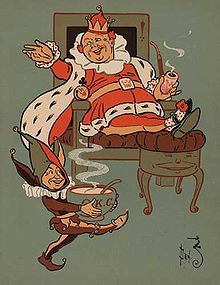
"Old King Cole" is a British nursery rhyme first attested in 1708. Though there is much speculation about the identity of King Cole, it is unlikely that he can be identified reliably as any historical figure. It has a Roud Folk Song Index number of 1164. The poem describes a merry king who called for his pipe, bowl, and musicians, with the details varying among versions.
Hey Diddle Diddle
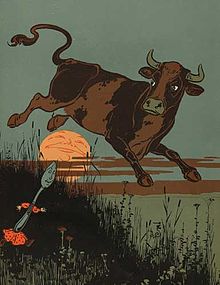
"Hey Diddle Diddle" (also "Hi Diddle Diddle", "The Cat and the Fiddle", or "The Cow Jumped Over the Moon") is an English nursery rhyme. It has a Roud Folk Song Index number of 19478.
Hey! diddle, diddle,
The cat and the fiddle,
The cow jumped over the moon;
The little dog laughed
To see such sport,
And the dish ran away with the spoon.
The cat and the fiddle,
The cow jumped over the moon;
The little dog laughed
To see such sport,
And the dish ran away with the spoon.
Nonsense
Nonsense is a communication, via speech, writing, or any other symbolic system, that lacks any coherent meaning. Sometimes in ordinary usage, nonsense is synonymous with absurdity or the ridiculous. Many poets, novelists and songwriters have used nonsense in their works, often creating entire works using it for reasons ranging from pure comic amusement or satire, to illustrating a point about language or reasoning. In the philosophy of language and philosophy of science, nonsense is distinguished from sense or meaningfulness, and attempts have been made to come up with a coherent and consistent method of distinguishing sense from nonsense. It is also an important field of study in cryptography regarding separating a signal from noise.


Orlando(film)
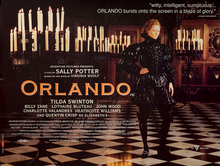
Orlando is a 1992 British film based on Virginia Woolf's novel Orlando: A Biography, starring Tilda Swinton as Orlando, Billy Zane as Marmaduke Bonthrop Shelmerdine, and Quentin Crisp as Queen Elizabeth I. It was directed by Sally Potter.
It was particularly acclaimed for its visual treatment of the settings of Woolf's 1928 novel. Potter chose to film much of the Constantinople portion of the book in the isolated city of Khiva in Uzbekistan, and made use of the forest of carved columns in the city's 18th century Djuma Mosque.
The film premiered at the 49th Venice International Film Festival, in which it entered the main competition.Orlando was re-released for screening in select cinemas in August 2010.


Tilda Swinton
Katherine Matilda "Tilda" Swinton (born 5 November 1960) is a British actress, performance artist, model, and fashion muse, known for her roles in independent and Hollywood films. She is the recipient of three BAFTA Awards, one BIFA Award, one Volpi Cup and an Academy Award for Best Supporting Actress and has received three nominations for a Golden Globe Award.
She began her career in films directed by Derek Jarman, starting with Caravaggio (1986), followed by The Last of England (1988) and War Requiem (1989). Swinton won the Volpi Cup for Best Actress at the Venice Film Festival for her performance as Isabella of France in Edward II (1991). She next starred in Sally Potter's Orlando (1992), and was nominated for the European Film Award for Best Actress.

Deep frying
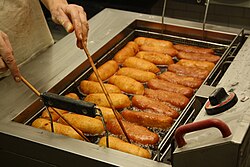
Deep frying (also referred to as deep fat frying) is a cooking method in which food is submerged in hot fat, most commonly oil, rather than the shallow oil used in conventional frying, done in a frying pan. Normally, a deep fryer or chip pan is used for this; industrially, a pressure fryer or vacuum fryer may be used. Deep frying may also be performed using oil that is heated in a pot. Deep frying is classified as hot-fat cooking method.Typically, deep frying cooks foods quickly: all sides of a food are cooked simultaneously as oil has a high rate of heat conduction.
Understatement
Understatement is a form of speech or disclosure which contains an expression of lesser strength than what would be expected. It is the opposite of an embellishment. The rhetorical form of understatement is litotes in which understatement is used for emphasis and irony. This is not to be confused with euphemism, where a polite phrase is used in place of a harsher or more offensive expression.

Bun
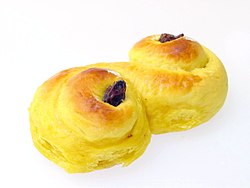
A bun is a small, sometimes sweet, bread, or bread roll.Though they come in many shapes and sizes, they are most commonly hand-sized or smaller, with a round top and flat bottom.
Buns are usually made from flour, sugar, milk, yeast and butter. Common varieties contain small fruit or nuts, are topped with icing or caramel, or filled with jam or cream. Some types of buns are filled with various meats.
"Bun" may also refer to particular types of filled dumplings, such as Chinese baozi. Some of these types of dumplings may be bread-like in texture.
Sieve
A sieve, or sifter, is a device for separating wanted elements from unwanted material or for characterizing the particle size distribution of a sample, typically using a woven screen such as a mesh or net or metal.The word "sift" derives from "sieve". In cooking, a sifter is used to separate and break up clumps in dry ingredients such as flour, as well as to aerate and combine them. A strainer is a form of sieve used to separate solids from liquid.


