Brothers Grimm
The Brothers Grimm (die Brüder Grimm or die Gebrüder Grimm), Jacob (1785–1863) and Wilhelm Grimm (1786–1859), were German academics, philologists, cultural researchers, lexicographers and authors who together specialized in collecting and publishing folklore during the 19th century. They were among the best-known storytellers of folk tales, and popularized stories such as "Cinderella" ("Aschenputtel"), "The Frog Prince" ("Der Froschkönig"), "The Goose-Girl" ("Die Gänsemagd"), "Hansel and Gretel" ("Hänsel und Gretel"), "Rapunzel", "Rumpelstiltskin" ("Rumpelstilzchen"),"Sleeping Beauty" ("Dornröschen"), and "Snow White" ("Schneewittchen"). Their first collection of folk tales, Children's and Household Tales(Kinder- und Hausmärchen), was published in 1812.

Wilhelm Grimm (left) and Jacob Grimm in an 1855 painting by Elisabeth Jerichau-Baumann
The Tyger
"The Tyger" is a poem by the English poet William Blake published in 1794 as part of the Songs of Experience collection. Literary critic Alfred Kazin calls it "the most famous of his poems,"and The Cambridge Companion to William Blake says it is "the most anthologized poem in English."It is one of Blake's most reinterpreted and arranged works.
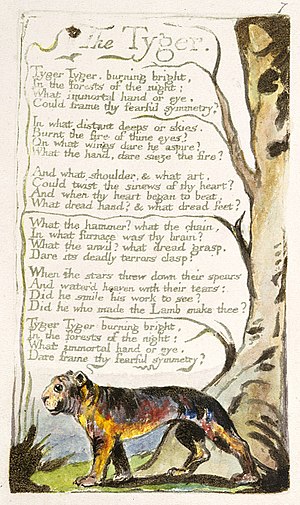
Copy A of Blake's original printing of The Tyger, c. 1795. Copy A is currently held by the British Museum
Hare
Hares and jackrabbits are leporids belonging to the genus Lepus. Hares are classified into the same family as rabbits. They are similar in size and form to rabbits and eat the same diet. They are generally herbivorous and long-eared, they are fast runners, and they typically live solitarily or in pairs. Hare species are native to Africa, Eurasia, North America, and the Japanese archipelago.
Five leporid species with "hare" in their common names are not considered true hares: the hispid hare (Caprolagus hispidus), and four species known as red rock hares (comprising Pronolagus). Meanwhile, jackrabbits are hares rather than rabbits.

A.A.Milne
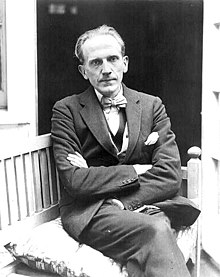
Alan Alexander Milne (/ˈmɪln/; 18 January 1882 – 31 January 1956) was an English author, best known for his books about the teddy bear Winnie-the-Pooh and for various poems. Milne was a noted writer, primarily as a playwright, before the huge success of Pooh overshadowed all his previous work. Milne served in both World Wars, joining the British Army in World War I, and was a captain of the British Home Guard in World War II.
Biography
Alan Alexander Milne was born in Kilburn, Londonto parents John Vine Milne, who was born in Jamaica,and Sarah Marie Milne (née Heginbotham) and grew up at Henley House School, 6/7 Mortimer Road (now Crescent), Kilburn, a small public schoolrun by his father. One of his teachers was H. G. Wells, who taught there in 1889–90.Milne attended Westminster School and Trinity College, Cambridge where he studied on a mathematics scholarship, graduating with a B.A. in Mathematics in 1903. He edited and wrote for Granta, a student magazine. He collaborated with his brother Kenneth and their articles appeared over the initials AKM. Milne's work came to the attention of the leading British humour magazine Punch, where Milne was to become a contributor and later an assistant editor. Milne played for the amateur English cricket team the Allahakbarries alongside authors J. M. Barrie and Arthur Conan Doyle.
J.M.Barrie
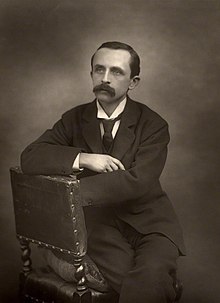
Sir James Matthew Barrie, 1st Baronet, OM (9 May 1860 – 19 June 1937) was a Scottish novelist and playwright, best remembered today as the creator of Peter Pan. He was born and educated in Scotland but moved to London, where he wrote a number of successful novels and plays. There he met the Llewelyn Davies boys, who inspired him to write about a baby boy who has magical adventures in Kensington Gardens (included in The Little White Bird), then to write Peter Pan, or The Boy Who Wouldn't Grow Up, a "fairy play" about an ageless boy and an ordinary girl named Wendy who have adventures in the fantasy setting of Neverland.
Although he continued to write successfully, Peter Pan overshadowed his other work, and is credited with popularising the then-uncommon name Wendy.Barrie unofficially adopted the Davies boys following the deaths of their parents.
Barrie was made a baronet by George V on 14 June 1913, and a member of the Order of Merit in the 1922 New Year Honours.Before his death, he gave the rights to the Peter Pan works to Great Ormond Street Hospital for Children in London, which continues to benefit from them.
Peter Pan
Peter Pan is a character created by Scottish novelist and playwright J. M. Barrie. A free spirited and mischievous young boy who can fly and never grows up, Peter Pan spends his never-ending childhood having adventures on the mystical island of Neverland as the leader of the Lost Boys, interacting with fairies, pirates, mermaids, Native Americans, and occasionally ordinary children from the world outside Neverland. In addition to two distinct works by Barrie, the character has been featured in a variety of media and merchandise, both adapting and expanding on Barrie's works. These include a 1953 animated film, a 2003 dramatic/live-action film, a TV series and many other works.


Arthur Conan Doyle
Sir Arthur Ignatius Conan Doyle KStJ, DL (22 May 1859 – 7 July 1930) was a Scottish writer and physician, most noted for creating the fictional detective Sherlock Holmes and writing stories about him which are generally considered milestones in the field of crime fiction.
He is also known for writing the fictional adventures of a second character he invented, Professor Challenger, and for popularising the mystery of the Mary Celeste. He was a prolific writer whose other works include fantasy and science fiction stories, plays, romances, poetry, non-fiction and historical novels.

Angela Lansbury
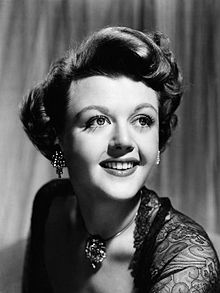
Lansbury was born to a middle-class family in central London, the daughter of actress Moyna Macgill and politician Edgar Lansbury. To escape the Blitz, in 1940 she moved to the United States with her mother and two younger brothers, and studied acting in New York City. Proceeding to Hollywood in 1942, she signed to MGM and obtained her first film roles, in Gaslight (1944) and The Picture of Dorian Gray (1945), earning her two Oscar nominations and a Golden Globe Award. She appeared in eleven further MGM films, mostly in minor roles, and after her contract ended in 1952 she began supplementing her cinematic work with theatrical appearances. Although largely seen as a B-list star during this period, her appearance in the film The Manchurian Candidate (1962) received widespread acclaim and is cited as being one of her finest performances. Moving into musical theatre, Lansbury finally gained stardom for playing the leading role in the Broadway musical Mame (1966), which earned her a range of awards and established her as a gay icon.
ChelseaF.C.
Chelsea Football Club (/ˈtʃɛlsiː/) is an English professional football club based in Fulham, London, that competes in the Premier League. Founded in 1905, the club's home ground since then has been Stamford Bridge.
Chelsea had their first major success in 1955, when they won the league championship. They then won various cup competitions between 1965 and 1996. The club's greatest period of success has come during the last two decades; winning 21 trophies since 1997. Chelsea have won five national league titles, seven FA Cups, five League Cups and four FA Community Shields, one UEFA Champions League, two UEFA Cup Winners' Cups, one UEFA Europa League and one UEFA Super Cup. Chelsea are the only London club to win the UEFA Champions League, and one of four clubs, and the only British club, to have won all three main UEFA club competitions.

E.H.Shepard
Ernest Howard Shepard OBE, MC (10 December 1879 – 24 March 1976) was an English artist and book illustrator. He is known especially for illustrations of the anthropomorphic animal characters in The Wind in the Willows by Kenneth Grahame and Winnie-the-Pooh by A. A. Milne.

Onomatopoeia
An onomatopoeia (/ˌɒnəˌmætəˈpiːə, -ˌmɑː-/, or chiefly NZ /-ˈpeɪə/; from the Greek ὀνοματοποιία;[ὄνομα for "name" and ποιέω for "I make", adjectival form: "onomatopoeic" or "onomatopoetic") is a word that phonetically imitates, resembles or suggests the source of the sound that it describes. As an uncountable noun, onomatopoeia refers to the property of such words. Common occurrences of onomatopoeias include animal noises such as "oink", "miaow" (or "meow"), "roar" or "chirp". Onomatopoeias are not the same across all languages; they conform to some extent to the broader linguistic system they are part of; hence the sound of a clock may be tick tockin English, dī dā in Mandarin, or katchin katchin in Japanese, or "tik-tik" (टिक-टिक) in Hindi.
Although in the English language, the term onomatopoeia means "the imitation of a sound," the compound word onomatopoeia(ονοματοποιία) in the Greek language means "making or creating names." For words that imitate sounds, the term Ηχομιμητικό (echomimetico or echomimetic) is used. Ηχομιμητικό (echomimetico) derives from Ηχώ, meaning "echo or sound", and μιμητικό, meaning "mimetic or imitation".

A sign in a shop window in Italy proclaims "No Tic Tac", in imitation of the sound of a clock.

沒有留言:
張貼留言